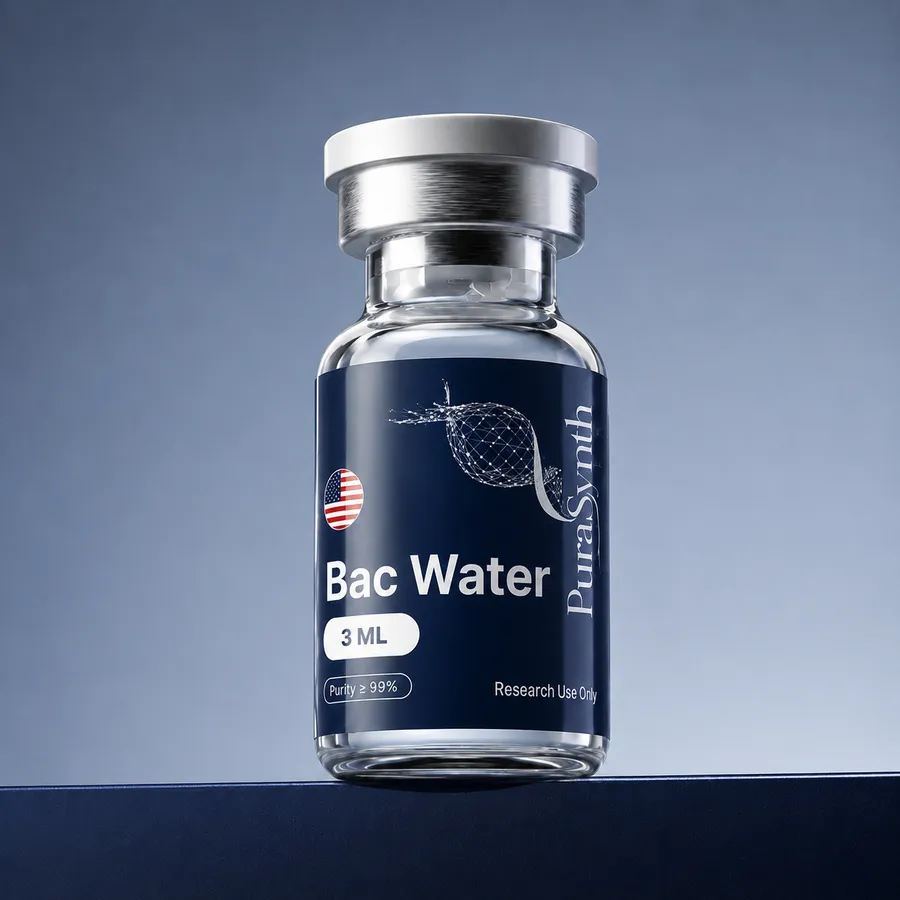
A Researcher's Guide to Reconstituting Lyophilized Peptides
A bench guide to reconstituting freeze-dried research peptides: solvent choice, gentle technique, concentration math, and clean aliquoting.
By PuraSynth Labs Research Team
Most research peptides ship as a lyophilized (freeze-dried) powder rather than a ready-to-use liquid, and for good reason. Removing water by sublimation under vacuum leaves a dry cake that is far more chemically stable during shipping and long-term storage than an aqueous solution, in which many peptides are prone to hydrolysis, oxidation, and aggregation. Before the material can be used in an in-vitro assay, it must be reconstituted into a defined stock solution. This guide covers the laboratory technique for doing that cleanly and reproducibly.
Everything below describes handling a research material on the bench. The objective is a well-characterized stock solution at a known concentration that can be aliquoted, stored, and dispensed into experiments with minimal loss of integrity.
Scope
This is laboratory technique for research-use-only reference materials. None of it describes preparing a material for administration to any living subject. Every concentration figure here is arithmetic for stock-solution preparation only.
Choosing a reconstitution solvent
Solvent selection depends on the peptide's solubility and the requirements of the downstream assay. Common laboratory choices include sterile ultrapure water and bacteriostatic water, the latter containing a low percentage of benzyl alcohol as a preservative. A preservative-containing solvent can suppress microbial growth in a stock that will be sampled over an extended period, whereas a preservative-free matrix is appropriate when benzyl alcohol could interfere with a sensitive cell-based readout. Match the choice to the analytical method, not to convenience alone.
Some peptides are poorly soluble in water alone. Hydrophobic or strongly self-associating sequences may require a pH-adjusted aqueous buffer or a small fraction of an organic co-solvent to dissolve fully. Always consult the certificate of analysis or published solubility data for the specific sequence before selecting a solvent, and keep any co-solvent fraction low enough that it will not perturb the assay system once the stock is diluted.
The reconstitution technique
Peptides are mechanically fragile in solution. Excessive shear and the air-water interface generated by vigorous mixing can promote denaturation, aggregation, and foaming, all of which reduce the amount of intact peptide available for an experiment. A slow, gentle approach protects the material.
- Let the sealed vial warm to room temperature before opening. Reconstituting a cold cake invites condensation onto the lyophilized material; warming first reduces moisture pickup.
- Calculate the solvent volume needed for your target concentration (see the math below) and draw it up accurately.
- Add the solvent slowly, directing the stream down the inner wall of the vial rather than blasting it directly onto the powder. Let it run gently over the cake.
- Allow the cake to wet and dissolve; many peptides go into solution within a few minutes at rest.
- Swirl gently or roll the vial between your fingers to assist dissolution. Do not shake or vortex aggressively, as this introduces shear and foam.
- Inspect the result. A clear, particle-free solution indicates the peptide has dissolved; persistent cloudiness or visible particulate may signal incomplete solubility and a need to revisit solvent choice.
Concentration math, worked through
Stock concentration is the mass of peptide divided by the volume of solvent added: milligrams of peptide per milliliter of solvent gives mg/mL. As pure arithmetic, a vial containing 5 mg of peptide reconstituted in 2 mL of solvent yields a stock at 5 / 2 = 2.5 mg/mL. The same 5 mg in 1 mL gives 5 mg/mL, and in 5 mL gives 1 mg/mL. A smaller solvent volume produces a more concentrated stock; a larger volume produces a more dilute one.
Choose the solvent volume so the resulting stock dilutes down to your assay working concentrations with reasonable pipetting volumes. Record the exact mass used and the exact volume added, since the labeled vial mass and your measured stock concentration are what every downstream dilution depends on. Where peptide content is specified by net peptide mass rather than gross fill mass, base the calculation on the value reported on the certificate of analysis.
Sterility and filtration for cell work
For in-vitro cell-culture applications, the stock should be free of microbial contamination and particulates. A common laboratory step is passing the reconstituted stock through a 0.22 micron syringe filter into a sterile receiving tube, which removes bacteria and particulate matter. Perform reconstitution and filtration using aseptic technique in a biosafety cabinet or clean area, with sterile consumables, to keep the prepared stock suitable for sensitive assays. Account for the small dead volume retained by the filter when precise final concentration matters.
Aliquoting and labeling
Repeated freeze-thaw cycles degrade peptides, so divide the reconstituted stock into single-use or few-use aliquots rather than freezing and thawing the whole vial repeatedly. Split the stock into small volumes appropriate to a typical experiment, and store them per the material's recommended storage conditions.
- Peptide identity and stock concentration (e.g. 2.5 mg/mL)
- Solvent used (e.g. bacteriostatic water) and any co-solvent fraction
- Date of reconstitution and preparer's initials
- Aliquot volume and a lot or batch reference for traceability
Clear labeling and a corresponding entry in the lab notebook tie each aliquot back to its source lot and certificate of analysis, which is what makes results traceable and reproducible across a research program.
Research Use Only. The information above is provided for educational purposes and describes laboratory and in-vitro research only. All compounds referenced are sold strictly as research materials — not for human or veterinary use, consumption, diagnostic, or therapeutic applications. Nothing here is medical advice.